
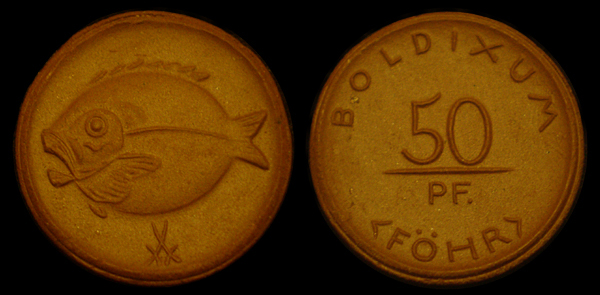
VILLAGE OF BOLDIXUM (GERMAN) 50 PFENNIG NO DATE
Village of Boldixum on the Island of Föhr Porcelain 50 Pfennig Coin Depicting a Fish.
This porcelain coin was minted by Meissen Porcelain Works for the village of Boldixum. Depicted on the obverse is a fish and the crossed swords trademark of the Meissen Porcelain Works. The reverse shows the denomination in the center, the village name above and the island name below. It is undated, probably minted before 1924. The island of Föhr is one of the three that make up the Geest (German North Sea) islands off the Wadden Sea coast of Schleswig-Holstein.
The island of Föhr was first mentioned in the 1231 Census Book of the Danish King Valdemar II. At this time, Föhr was not an island but a part of the mainland and the sea had yet to rise around it. Sometime in early 1363 there were massive storms and surges which flooded the coastal areas killing many thousands of people and animals. At the time of these floods, the Islands of Föhr, Sylt and Amrum formed from the mainland and were then known as the North Frisian Islands.
Boldixum is the home to the 13th century Church of St. Nicholas, it is one of the oldest villages on Föhr. In 1924 it was incorporated as a district of the newer port and seaside resort town of Wyk.
Wyk is first mentioned as a small cluster of houses, a fishing community, in the mid 17th century. The port town was officially founded in 1819 with an eye towards tourism. Wyk quickly became the urban center of the island and has greatly expanded. It now contains more than half of the population of the island including formerly independant early villages such as Boldixum and Südstrand.
Wyk houses both modern urban areas and forested residential areas as well as an airport and seaside resort. The other island villages are either clustered or aligned parallel towards the marshland. The buildings are usually in a low, traditional style, and include historic windmills and churches. Distinctive Frisian houses are still common here either as originals preserved or restored buildings dating back to the 17th century or as new buildings in the traditional style.
Archaeological evidence shows remnants of ancient settlements in the marshes and fortifications from the early Middle Ages as well as hundreds of burial mounds, most which have vanished over time. The islands have changed hands several times and its influences are German and Danish but their relative isolation has often afforded a certain immunity to the effects of kings drawing and redrawing borders. Today it is a part of Nordfriesland District in the German federal state of Schleswig-Holstein.
Farming has always been an important part of life on the island and is even more so today. Fishing played a big role in the history of Föhr as did whaling and trading for a time. With the establishment of a seaside resort in 1819 (one of the oldest) Föhr became the seaside vacation destination of the well off.
Many came on the advice of their doctors who perceived climatic advantages to spending time on the island. It remains a popular vacation destination today. The islands population is roughly 8,600, about half of these people live in Wyk (including Boldixum). During tourist seasons the population in and around the town can be as high as 20,000.
This reddish brown stoneware coin displays the crossed swords found on every product of the famous Meissen porcelain works since 1722 including the white and brown porcelain coins and medals minted during this time. Although both white and brown porcelain coins and medals were produced, brown porcelain was often preferred over white for circulation due to the fact that it was less effected by dirt, breakage and wear. Although the use of porcelain for coins and medals was not a new concept as Meissen had produced its first porcelain medallion as far back as 1710, regular production of German porcelain coins as currency for a variety of towns, cities, and regains (emergency money and donation coins) began at the end of 1920 and in the first months of 1921.
A limited number of these coins were produced from plaster casts for Germany and for the State of Saxony. These earlier limited issue coins are remarkable for having finer, less sharp lines, rougher surfaces and are thinner than the ones later minted from steel moulds. Later issues such as the one pictured above were produced in large numbers from steel casts and are characterized by thicker flans and sharper detail. Porcelain coins with face values from 10 pfennigs to 20 marks were issued in a variety of types and numbers for many German cities and regions at the beginning of the 1920s. Although these coins were reportedly very popular do to their attractive, interesting and varied designs, they were impractical as coinage do to the fact that they broke rather easily and did not hold up the rigors of circulation for long. They ultimately failed as currency thus circulation of these coins was very limited though commemorative and special issue porcelain coins and medals continued to be produced.