
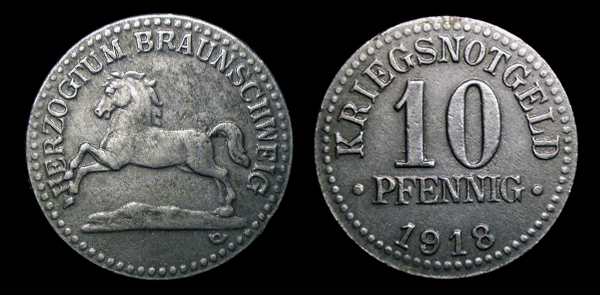
DUCHY OF BRAUNSCHWEIG (GERMAN) 10 PFENNIG 1918
L- 54.2 Herzogtum (Duchy) of Braunschweig (German) 10 Pfennig 'KriegsNotgeld' (War Emergency Money) Coin Depicting Horse.
The city of Braunschweig is the largest city in the south-eastern part of Lower Saxony with a population of around 240 000. Roughly 40 miles southeast of Hanover It sits on the Oker River north of the Narz mountains. Braunschweig was the residence of the duchy of Braunschweig which was a state within the German Reich since 1871 until it received a republican constitution after World War I becoming a state within the Weimar Republic. After World War II the state of Braunschweig was dissolved and integrated in the newly formed state of Lower Saxony.
Although the exact circumstances of the founding of the city is unknown, because of its ideal location on major trade routes, Braunschweig probably developed from a supply and resting place (Wik) which was set up by traveling merchants over 1000 years ago. The favorable location of the market settlement caused Henry the Lion to choose Braunschweig as his place of residence during the middle of the 12th century. This initiated Braunschweig's development into a large medieval city.
The structure of the city was unique. It consisted of five districts: Altstadt, Hagen, Altewiek, Neustadt and Sack. Each of these districts had its own constitution, town hall, market and, with the exception of Sack, its own parish church. Under the guidance of merchants, who were primarily residents of the Altstadt district, trade and commerce flourishing and the city prospered during the 13th and 14th centuries.
The Collegium Carolinum was founded in 1745 which eventually became the present technical university. The opening of the ducal art and natural products cabinet were of importance and became the nucleus for the Museum of Natural History (Staatliche Naturhistorische Museum) and the Duke Anton Ulrich Museum (Herzog Anton Ulrich-Museum) which displays masterpieces by Cranach, Hollbein, Van Dyck, Reubens, Rembrandt, Vermeer van Delft and others. Music and theatre also made the city into a cultural centre as the first important bourgeois tragedy in German, Lessing's "Emilia Galotti" (1772) and Goethe's "Faust I." (1829) were premiered in Braunschweig.
|
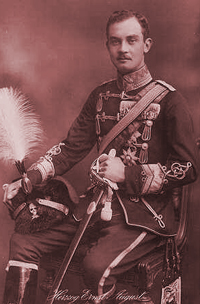 |
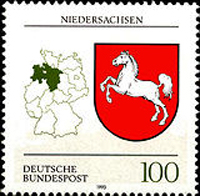
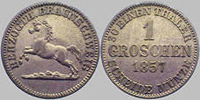
| Postage stamp for Braunschweig showing the town crest and location (top).The coin is very similar to this 1 Groschen coin minted in 1857 (bottom). | Ernst August, the last reigning Duke of Braunschweig-Luneburg. The monarchy was abolished after WWI |
During World War I, 15,000 servicemen from the Braunschweig region lost their lives and towards the end of the war, Braunschweig became a centre of social unrest and political protest. The Revolution of 1918/19 eventually lead to strong polarization between the working class and the middle class. This was a decisive influence on political developments during the time of the Weimar Republic and the National Socialist period.
Braunschweig holds the dubious honor of being the city in which Adolf Hitler gained his German citizenship as he was employed by the Braunschweig State Government in February 1932 and thereby obtained German citizenship. The later site selection of the Volkswagen plant in nearby Wolfsburg (Fallersleben) was likely a thank-you gift for this granting of citizenship.
Dietrich Klagges (Minister of National Education and the Interior) was the central figure of National Socialist rule in Braunschweig and During World War II the city became a Sub-area Headquarters of Military District XI. It was also the Garrison Town of the 31st Infantry Division, which took part in the invasions of Poland, Belgium, France, and Russia. It was one of the units that was destroyed during the withdrawal from Russia at the end of the war.
Countless Jews, Sinti, Roma, homosexuals and Jehovah's Witnesses from Braunschweig became the victims of Nazi persecution and extermination. Foreign forced laborers and prisoners of concentration camps suffered and died in many places in Braunschweig.
Like may German population centers during World War II, air raids killed thousands and decimated the city. After the war the reconstruction of the city with modern buildings and wide streets began. Public buildings and churches were rebuilt and scientific institutes were moved into the city. Braunschweig is now a major economic and cultural center of the region and enjoys a healthy economy as it is home to many international businesses and manufacturing concerns making and exporting products like cameras, pianos, and automobiles.