
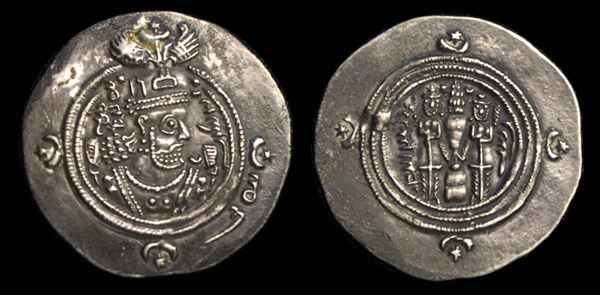
AR Drachm - KING KHUSRO II
Born: 570 (est)
King: A.D. 590-628
Obverse: Portrait of king crowned head right - KHUSRO (to right of head) MAY HIS GLORY INCREASE (to left of head) GOOD (Lower right margin)
Reverse: Two attendants / guards flanking fire altar - MINT MARK (right) and DATE (left)
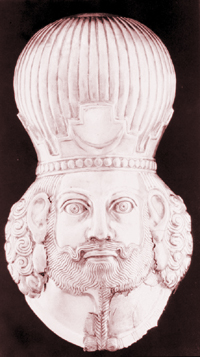 |
Inscriptions: GREAT KING KHUSRO THE GOOD MAY HIS GLORY INCREASE There are many different spellings for the name of this Persian King and very little consensus as to how it should be spelled. Other spellings for this name are: Khusrow, Khosrow, Khusrau, Khosrau, Chosroes, Xosro. He is also sometimes refered to as Aparvez or "The Victorius" The coin Depicts the King wearing a winged crown with three merlons, three short diadem ties behind, a crescent in front surmounted by star inside a double dotted-border. The reverse of the coin shows the common theme of two attendants (or guards) flanking a flaming altar (a scene symbolic for the Zoroastrianism religion the Sassanians followed.) inside a triple dotted-border. The obverse has crescents and stars at 3, 6, 9 and on the reverse one is added at 12 o'clock. Khusro II came to power after his father was killed during a palace revolt. A rival to the throne in the form of general Bahram Chobin proclaimed himself King taking the name Bahram VI. In a vulnerable position with a powerful rival Khusro II had to deal with this threat before he could turn his attention to concluding the on going war against the Byzantine Empire. Bahram was soon defeated and fled into exiled to be killed by his hosts and Khusro quickly made peace with Constantinople. In 602 The Emperor Maurice who had aided Khusros in his struggle against Bahram was murdered by his successor, general Phocas. Khusro promptly went to war plundering Syria and Asia Minor, taking Damascus and Jerusalem as well as the so-called True Cross. The Roman Empire struggled to field any resistance to Khusros rampaging armies until the accession of the Emperor Heraclius who succeeded Phocas in 610 and ruled until 641. Heraclius was able to calm the tumultuous empire, field an army, and defend Constantinople as well as retrieve much of the stolen territory lost. In 627 Heraclius defeated the Persian army at the Battle of Nineveh and advanced towards the Persian capitol of Ctesiphon. Khusro II fled his residence near modern day Baghdad without resistance. Faced with advancing enemy armies and dissention in his own ranks his eldest son Kavadh II was briefly proclaimed King and Four days later Khusro II was murdered in his palace. Khusro II was characterized as having paled in comparison to his revered grandfather Khusro I who is considered the greatest of the Sassanid Kings. He is said to have been cruel and accustomed to luxury, neither an able general or an able administrator. Khusro II ruled during the meteoric rise of early Islam and is remembered as one of the powerful kings of the Persian Empire to whom Mohammed sent messengers with the word of Islam. He is said to have torn up the message and insulted the messenger. Ironically it would be these forces that would soon destroy the Persian Empire as a united Islamic army and religion rapidly spread from the Arab Peninsula to engulf much of the east. Khusro II was Succeeded by his son Kavadh II who would only reign for a few months followed by a quick succession of Kings that would end just 23 years later as Persia is defeated and over run by Islamic Invaders. |