
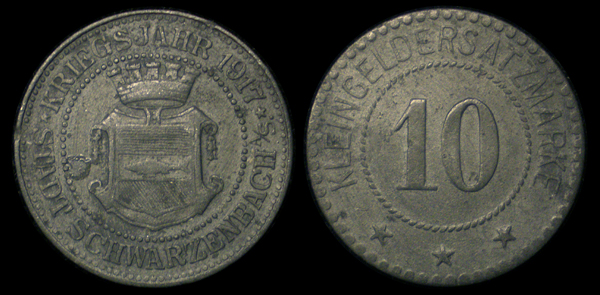
STADT SCHWARZENBACH (GERMAN) 10 PFENNIG 1917
L- 475.3 City of Schwarzenbach an der Saale (Bavaria) Zinc 10 Pfennig Coin Depicting City Coat of Arms.
This zinc 10 pfennig coin was issued by the City of Schwarzenbach an der Saale and depicts the city coat of arms. On the obverse it says Kriegsjahr which literally translates as 'War Years'. On the reverse it says Kleingeldersatzmarke meaning roughly 'Small Money Substitute'. Coins like this one were common and meant to be used as small change.
Schwarzenbach is a German town in the state of Bavaria on the river Saale. The town was a possession of the Margraves of Bayreuth in some form or another beginning in 1398 when the son of Burgrave Friedrich V of Nuremburg passed away and his lands were briefly partitioned between his two sons. The elder son, John III, received Bayreuth but the lands were soon reunited under the younger son Friedrich VI after the death of John in 1420. The ruling Hohenzollern princes of the land were known as margraves, as the principality was a margraviate and a state of the Holy Roman Empire.
On Friedrichs death in 1440 they were again partitioned between his three sons with Bayreuth (and with it Schwarzenbach) going to the eldest son, John "the Alchemist". John the Alchemist renounced his rights in 1457, whereupon his lands passed to his brother, Albert Achilles, the Margrave of Brandenburg. From then the principality would be held by the cadet branches of the House of Brandenburg and would be commonly known as Brandenburg-Bayreuth. By 1500 it was a part of the Franconian Circle.
The Margrave of Brandenburg-Bayreuth bestowed market rights to Schwarzenbach in 1610. In 1655 these lands were again partitioned only to be reunited again in 1726. The last line of Brandenburg-Bayreuth died out in 1769 with the death of Margrave Friedrich Christian, and his lands passed to Christian Friedrich, the Margrave of Brandenburg-Ansbach who sold his principalities to King Frederick William II of Prussia in 1791. Under the terms of the contract, Prussia paid the Margrave as compensation an annual stipend of 300,000 guilders. These lands were then ruled through Prussian-appointed governors.
The Franconian region over which the Margraves of Brandenburg-Bayreuth had ruled changed hands many more times. In 1805, in the first Treaty of Schönbrunn, Prussia ceded the the territory to France in exchange for the Electorate of Hanover. In 1806 they were then acquired by the Kingdom of Bavaria in exchange for the Duchy of Berg, and soon afterwards, the Prussian defeat at Jena in 1806 resulted in the cession of the Principality of Bayreuth to the French in the Treaty of Tilsit in July 1807. In 1810, Bayreuth was acquired by Bavaria. Finally, in 1871, Bavaria was incorporated into the North German Confederation to form a German Empire under Prussian control. Today it remains a part of the German State of Bavaria.
After the city gained its market rights in 1610, Schwarzenbach an der Saale received the seal of law. The first seal bears the date 1610 and the coat of arms which was again confirmed by King Ludwig I in 1837. The coat of arm consists of fields of blue and green divided by a silver wave inside of which is a red fish.
Traditionally the main industries of Schwarzenbach are porcelain, textiles, iron casting, machinery, shoes, and yeast.