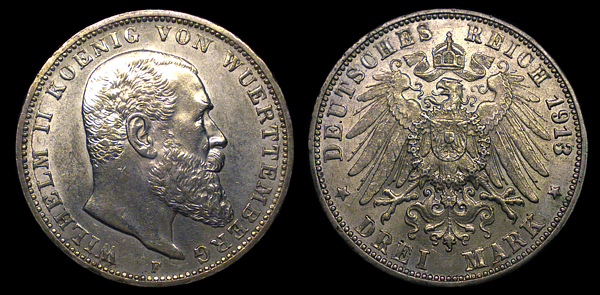
3 MARKS COIN - WURTTEMBERG - WILHELM II
(KM 635)
Date: A.D. 1913
Obverse: Portrait head right - WILHELM II KOENIG VON WUERTEMBERG F
Reverse: German Imperial crowned eagle with crest - DEUTSCHES REICH 1913 DREI MARK
Edge: GOTT MIT UNS (God with us)
|
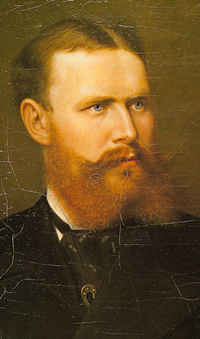
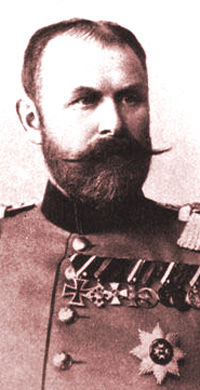
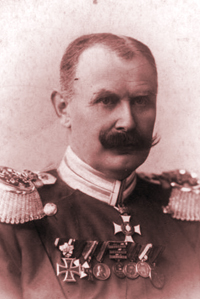
Wilhelm (II) Karl Paul Heinrich Friedrich was born on February 25, 1848 in Stuttgart. His parents were Prince Friedrich of Württemberg and his cousin Princess Catherine. Catherine was daughter to King Wilhelm I. Friedrich was the son of Prince Paul, the fourth child and second son of Duke Friedrich III, first to be recognized as King of Württemberg as Friedrich I. Formerly a part of the Holy Roman Empire, Wilhelm's great grandfather was made Prince-Elector in 1803 and then King in 1806. The Kingdom seceded from the Empire and joined the German Confederation in 1815. Upon the death of King Frederick, his eldest son Wilhelm Friedrich Karl became King Wilhelm I. Wilhelm I ruled for 48 years passing the kingdom to his son Karl Friedrich Alexander who ruled as Karl I. Under Karl the Kingdom would become a part of the new Deutsches Reich (German Empire.) The Prince enjoyed scholarly pursuits and an active social life. He studied law in school and eventually joined the Prussian military based in Potsdam but found he was not fond of military life. In 1877 he married Princess Marie of Waldeck-Pyrmont who gave birth to their daughter, Princess Pauline, that same year. In 1880 they had a son who did not survive his first year. In 1882, Princess Marie died giving birth to a still born daughter. In 1886 he married Princess Charlotte of Schaumburg-Lippe. It is believed that his Uncle, King Karl, was homosexual. He had created some scandal for his involvement with several close male companions whom he employed and were thought to be his lovers. Wilhelm was made heir to the throne as It became apparent that King Karl would remain childless. As heir to the throne, he found himself becoming more involved with the politics of the kingdom. Upon Karl's death in 1891, Wilhelm succeeded him to rule as King Wilhelm II of Württemberg. Although he served as a part of the military culture that flourished under the Deutsches Reich, he preferred social gatherings with friends over military life. All the same Wilhelm served as Generalfeldmarschall (Field Marshal General) when Württemberg troops fought for the German Empire in World War I.
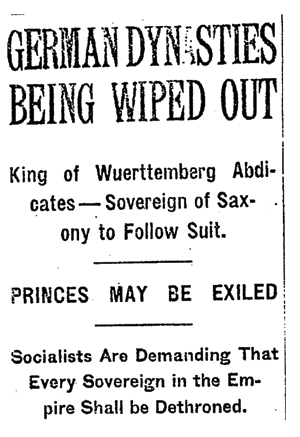
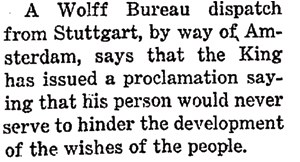
Poverty, starvation and economic collapse following Germany's eventual defeat gave rise to social unrest and upheaval. Socialists who had found a modicum of tolerance under his rule soon stormed Wilhelm's Palace during a revolutionary movement aimed at removing royals from power. On November 30, 1918, Wilhelm I abdicated to live the remainder of his life as a private citizen. After his Abdication he kept the title of Duke and remained the head of the House of Württemberg.
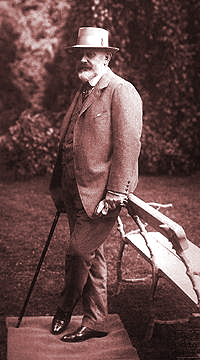
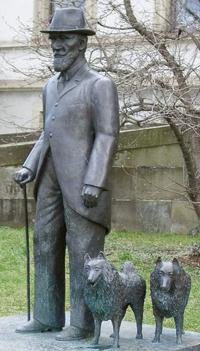
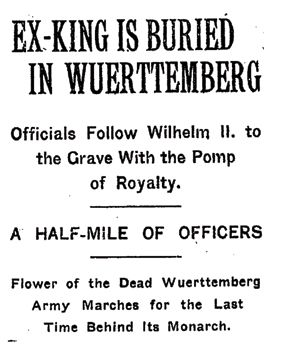
He was generally a popular king as evidenced in the fact that he freely walked his dogs in public with no bodyguard and was greeted by the populace as Heir Koenig (Mr. King). Queen Charlotte used the influence of her position to promote and support numerous charities, the arts, education, and to further the rights of women. Wilhelm died on October 2, 1921. Military officers and veterans marched one last time to escort the old king to his final resting place next to his first wife in a Ludwigsburg cemetery. Not having produced an heir, he was succeeded by his cousin Duke Albrecht, A brilliant military commander who hailed from the fifth or Ducal branch of the Württemberg family.
|