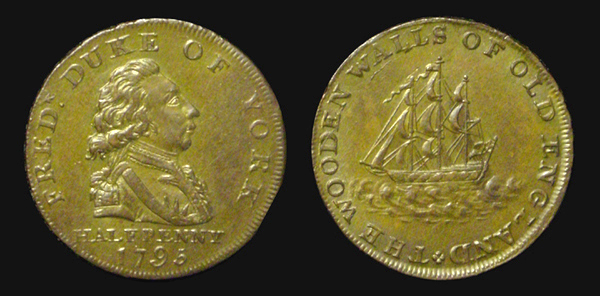
HALF PENNY TOKEN - MIDDLESEX - DUKE OF YORK - WOODEN WALLS OF OLD ENGLAND
(D&H 985)
Date: A.D. 1795
Obverse: Portrait head right - FRED: DUKE OF YORK HALFPENNY 1795
Reverse: Ship - THE WOODEN WALLS OF OLD LONDON
|
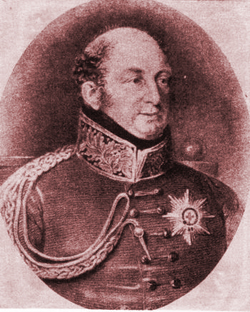
Middlesex D & H 985 Half Penny Depicting the Duke of York and Ship (Wooden Walls of Old England) In the late 1600's to the late 1700's copper coinage was produced sporadically, sometimes not at all, for various reasons. Conder Tokens (named after James Conder) are copper coins (usually pennies and half pennies) Printed by towns, businesses, and organizations of all types to meet a need for low denomination coinage to pay wages and make change. Thousands of varieties of tokens were minted and many are beautiful and intricate. The Prince Frederick, Duke of York and Albany (Frederick Augustus) was the second son of King George III and Queen Charlotte born on August 16, 1763 to the German Royal House of Hanover who ruled in Britain. When he was just six months old he was elected Prince-Bishop of Osnabrück in Lower Saxony thus becoming the youngest bishop in history. He was invested as Knight of the Most Honorable Order of the Bath in 1767 and as a Knight of the Order of the Garter in 1771. His father, who favored him over his other sons, decided he would pursue a life in the military and he was made a colonel in 1780 at the age of 17. For the next six year the Prince lived in Hanover where he accompanied the Austrian and Prussian armies learning to be a soldier and studied (along with his younger brothers, Prince Ernest, Prince Edward, Prince Augustus and Prince Adolphus) at the University of Göttingen. He was rapidly promoted and by 1784 he was ranked as major-general and appointed colonel of the Coldstream Guards. He was created Duke of York and Albany and Earl of Ulster and became a member of the Privy Council in this same year. In 1787 rumors circulated in America saying that the government was to invite Prince Frederick to become "King of the United States". This never happened and was most likely simply not true. In 1791, the Duke of York married his cousin Princess Frederica Charlotte of Prussia, the daughter of King Frederick Wilhelm II of Prussia and Elisabeth Christine of Brunswick-Lüneburg but it was a troubled marriage and the two soon separated. The Duchess retired to Weybridge, where she died in 1820. The Duke never remarried and never had any children though it was rumored he had several illegitimate children with mistresses. In 1793, the Duke of York was sent to Flanders in command of a British army contingent to participate in the invasion of France. On his return his father promoted him to the rank of field marshal and appointed him Commander-in-Chief. 1799 saw him in command of the army sent to invade Holland in conjunction with a Russian troops. Following the success of the British navy to clear the way for his armies to land the allied forces fared poorly and the Duke eventually signed the Convention of Alkemaar which required the withdraw of all allied troops and the surrender of all prisoners taken. Later he would be responsible for many major reforms in the army which would lead to subsequent successes in the Napoleonic Wars. He resigned as commander-in-chief of the army in 1809 as a result of a scandal concerning his mistress Mary Anne Clarke and charges of receiving bribes. A select committee was appointed by the House of Commons to investigate who acquitted the Duke. Two years later it was revealed that he was indeed innocent of the charges and the Prince Regent reappointed him as commander-in-chief, a post he held until his death. In 1817 his niece, Princess Charlotte of Wales, passed away and the Duke of York became second in line to the throne and then heir presumptive when George III died in 1820 leaving his brother, George IV, on the throne. In 1827 The Duke died at the home of the Duke of Rutland on Arlington Street, London. He was buried at St. George's Chapel. Although a consummate and able soldier and military administrator, his military failures are often best remembered as they were immortalized in the rhyme: The grand old Duke of York, Fredericton, the capital of the Canadian province of New Brunswick as well as the township of Fredericksburg in Ontario were named after Prince Frederick. |